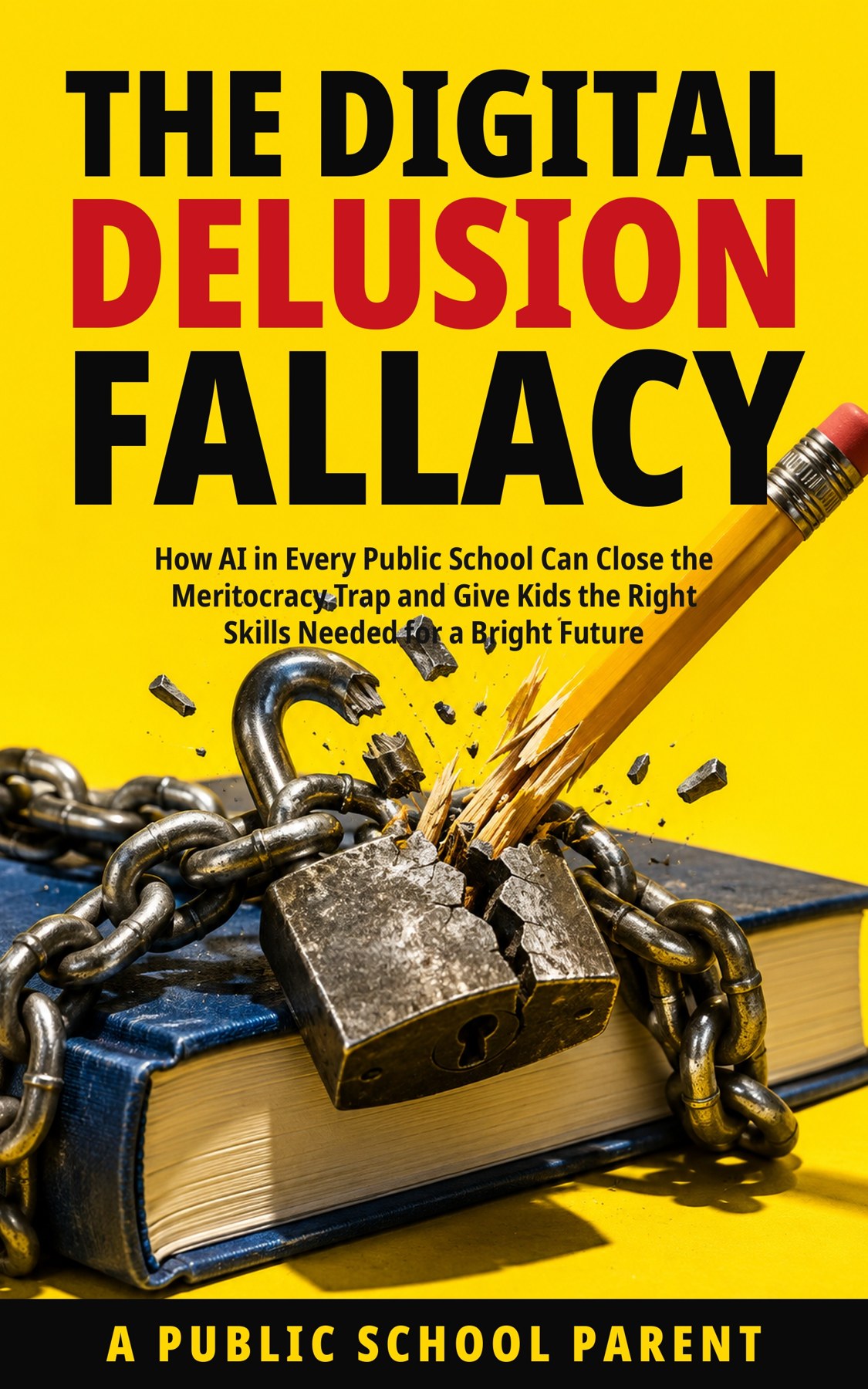
A BOOK BY MANUEL ARTEAGA
What if the tool we fear could help the child we worry about most?
A child falls behind. One parent can pay for help. Another can't. Why should that decide who gets ahead?
Find the book Check availability at each ebook store before buying.The merit trap
We praise hard work, then sell the extra attention that makes hard work pay off.
Every parent knows the feeling: your child is stuck, and you would do anything to help. Some families can buy a tutor who stays until the idea clicks. Others cannot.
Now a tool that could bring more of that attention into public schools is being treated as if it were just another screen or a shortcut. Those tools can hurt learning. A tutor designed to ask, wait, hint and make a child think is a different proposition.
Two cities. One urgent debate.
New York City has paused student-facing generative AI from its youngest classrooms through eighth grade. Nearly 600,000 children are affected. Carefully supervised pilots will run in high school, but not for the younger children in the pause.
Los Angeles Unified has blocked student access to generative AI tools on district-issued devices. Its restriction is not limited to K–8. The districts say they are protecting learning and human connection. Those concerns deserve to be taken seriously.
“The children waiting for help cannot buy back a school year.”
A teacher's story,
not a replacement story
No machine notices the quiet child who stopped trying, earns a family's trust or decides what a classroom needs. Teachers do. The book's case is not to replace them. It is to give them more time to do the work only they can do: coach, question, encourage, and know each child.
Imagine a teacher who can see where a student got stuck before the next lesson. A tutor guides practice without writing the answer. The teacher decides what to teach, which tool to use and when to turn it off. Less time spent on repetitive drills could mean more time for the conversation that changes a child's day. That is a possibility to test, not a promise that AI will make every job easier.
A Stanford study offers one glimpse: an AI assistant suggested teaching moves to human tutors, and students working with those tutors were four percentage points more likely to master their math topics. It did not show that AI can replace teachers, or that every AI product helps. Read the Tutor CoPilot study ↗
Demand proof.
Not a permanent pause.
The Digital Delusion Fallacy agrees with the critics on what goes wrong: aimless screen time, open chatbots that hand out answers, and technology sold to schools without proof. It rejects the leap from “those tools can harm” to “no young student should get to try a carefully designed tutor.”
It asks for small, teacher-led pilots with clear learning goals, privacy protections and published results. If a tool fails, stop using it. If it helps, don't make the child's family income the reason they never see it.
Manuel Arteaga
Manuel Arteaga is a product of public schools and a parent of two, and the author of The Digital Delusion Fallacy. He attended Iowa City public schools and is a Brooklyn father of two whose sons now attend private schools. He knows his family can buy choices many families cannot. That is why he wants public-school parents and teachers in the room when decisions about AI are made.
50% of royalties from the book will go to help PTAs, charter schools, and public schools introduce AI into schools.
The conversation
is just beginning.
Join Parents & Teachers for Better Schools for occasional updates on AI and education news, research worth reading, and questions to ask your school. The address you provide is used for these updates; ask to leave at apublicschoolparent@gmail.com.
Join the email list